%20(1).svg)
2026 South Florida Commercial Real Estate Outlook
Based on Key Takeaways So Fl Business Journal January Briefing and Costar Analytics
South Florida Entered 2026 with Momentum- South Florida continues to outperform many U.S. regions in population growth, business formation, and capital migration. While 2025 was not a broad-based expansion year, it marked stabilization across most property types following the 2023–2024 capital markets reset.
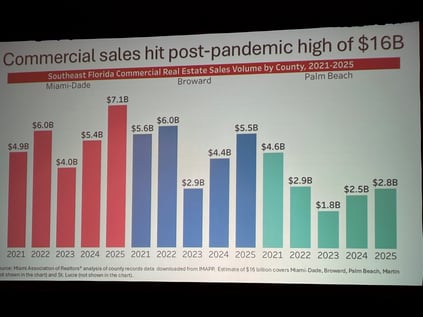
Commercial sales volume across Miami-Dade, Broward, and Palm Beach reached over $15 billion in 2025 — a post-pandemic high. Transaction velocity improved meaningfully, particularly in stabilized assets. For owners, the environment has shifted from rapid appreciation to selective performance. Asset quality, tenant durability, submarket positioning, and capital structure now matter more than macro headlines.
Office: Flight to Quality — and Structural Divergence- South Florida’s office market remains bifurcated. Class A and recently renovated buildings continue to attract tenants, particularly in well-located corridors across Fort Lauderdale, Boca Raton, and Coral Gables. Demand is increasingly concentrated in higher-quality space that supports hybrid work environments and talent retention. Older, commodity office buildings remain under pressure, particularly those lacking modernization or strategic location advantages. Within this broader office environment, medical office continues to demonstrate relative stability.
Medical office occupancy levels remain significantly stronger than traditional office. Vacancy remains low compared to conventional office inventory, and leasing activity has shown modest improvement over the past year. New construction is limited across the region, particularly in Broward and Palm Beach, where development remains highly location-specific.
Hospital systems and outpatient expansion continue to support long-term demand in suburban corridors. Infill locations with strong demographics and healthcare access continue to command premium rents relative to aging inventory. Medical office rent growth has moderated, but long-term trends remain intact. Investor interest remains concentrated in smaller, stabilized assets — often in the sub-$10 million range — where private capital is active.
Owner takeaway: “Flight to quality” is real across office. For medical office owners, fundamentals remain structurally stronger than traditional office, particularly in suburban, hospital-adjacent markets in Broward and Palm Beach.
Industrial: Bifurcated but Fundamentally Sound- Industrial remains supported by long-term structural drivers:
- Port activity
- Airport cargo capacity
- Population growth
- Regional distribution demand
However, leasing has become more segmented. Smaller-bay industrial space (under 50,000 SF) remains tight in many submarkets. Larger warehouse assets face more vacancy and slower absorption. New supply has tapered, which should support gradual rebalancing in 2026.
Owner takeaway: Industrial fundamentals remain durable, but asset size and location matter more than broad market averages. Infill product and smaller-bay assets continue to show resilience.
Retail: One of the Strongest Performing Sectors- Retail vacancy across South Florida remains among the lowest nationally. Population growth, tourism, and high-income household concentration continue to support demand. New construction remains limited, particularly in mature Broward and Palm Beach corridors. Grocery-anchored and necessity-based retail centers continue to perform well, while well-located neighborhood centers benefit from strong residential density.
Owner takeaway: Retail remains one of the more stable sectors in South Florida. Well-positioned centers with durable tenant mixes remain attractive to private and institutional buyers alike.
Multifamily: Stabilization Before Acceleration-After a wave of new deliveries in 2023–2025, multifamily vacancy has increased modestly in certain submarkets. Rent growth has moderated but remains positive in many suburban areas. As new construction slows, fundamentals are expected to gradually rebalance —particularly in submarkets with limited additional pipeline.
Owner takeaway: Multifamily is entering a normalization phase. Timing and submarket selection are increasingly important.
What 2026 Means for South Florida Owners- 2026 is shaping up to be a selective opportunity year — not a broad appreciation cycle. Transaction momentum has returned, but capital is concentrated in stabilized assets, strong suburban corridors, and income-durable properties. Private and 1031 buyers remain active across Broward and Palm Beach, particularly in smaller medical office, retail, and infill industrial transactions. South Florida’s long-term drivers — migration, wealth concentration, healthcare expansion, and constrained land supply — continue to differentiate it from most U.S. markets. That structural advantage supports pricing stability, even as underwriting remains disciplined.
Within the office category, medical office remains one of the more structurally resilient segments, particularly in suburban Broward and Palm Beach corridors where healthcare demand is stable and supply remains constrained. South Florida is not a uniform market — outcomes vary widely by asset class and submarket. Owners who understand capital flows, buyer profiles, and localized demand drivers will be best positioned in this next phase of the cycle.